














NO MATTER YOUR VISION.
WE GUIDE YOU
WE GUIDE YOU
For over 30 years, Veldhoen + Company has developed and implemented new ways of working for forward-thinking organisations.
15 min read
Is AI a Tool or a Teammate?
Rethinking Work Through the Lens of Activity
Most organisations have adopted AI. Some have run the training. A few are even tracking usage metrics. And yet when you ask people whether the way they work has fundamentally changed, the honest answer is usually: not really. The problem isn’t technology. It’s that we haven’t asked the real question: who should do what? At Veldhoen + Company, we think the answer starts with looking at work through the lens of the activities that happen in the workplace.
The Question Beyond “Efficiency”
It’s been roughly two years since generative AI tools like ChatGPT became a fixture of everyday professional life. Many organisations have rolled out AI tools, run pilots, and seen individual productivity gains. Drafting documents, summarising meetings, searching and organising information; most people now have firsthand experience of AI saving them time.
But this question might give you pause:
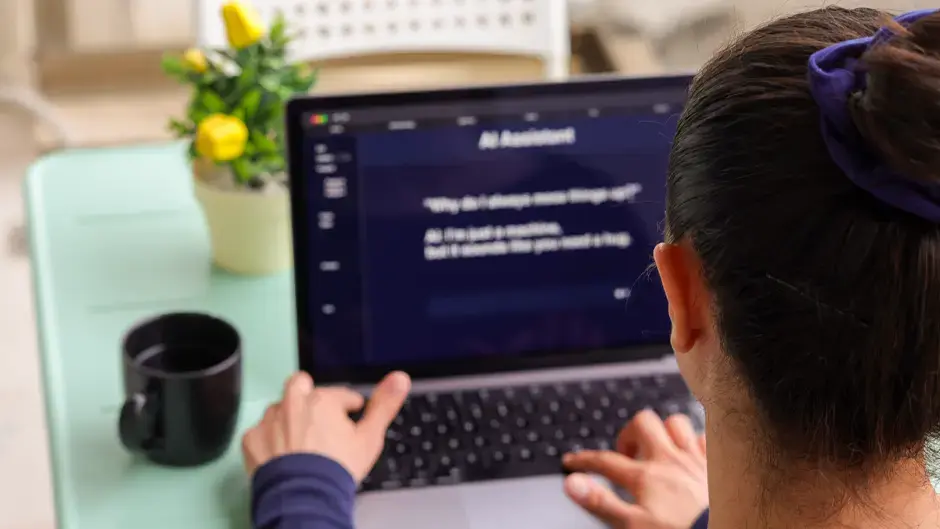
“Has the way your organisation actually works changed since you adopted AI?”
You may have the tools, the training, or the usage metrics. But does it feel like something has genuinely shifted at an organisational level? For many, the honest answer is 'not quite'.
There’s a reason for that gap. Individual efficiency and organisational transformation are two different problems. The first is a question about tooling. The second is a question of design, specifically, who should be doing what. And to think clearly about that design question, we at Veldhoen + Company find it useful to look at work through the lens of activities in the workplace.
What Does Work Look Like Through the Activity Lens?
Describing an organisation’s work in terms of job titles and departments is familiar enough. But designing the right relationship between AI and people requires a different way of seeing.
Through years of experience, we have come to understand work as a collection of distinct activities. Everyone’s day consists of different work modes: deep-focus work, collaboration with the team, one-on-one conversations, and unstructured time. Each activity has its own character and requirements.
What matters here is a simple but important insight: different activities have different affinities with AI.
Not All Work Is Equal, and Neither Is AI
AI excels at individual, task-based work: searching and organising information, drafting text or aggregating data. But activities like meaningful dialogue, building trust, and managing team motivation remain, for now, distinctly human territory.
Whether something can be handed off to AI isn’t a question of technology. It’s a question of the activity’s nature.
Take brainstorming. We’ve traditionally thought of it as a group activity. But when someone works through ideas in a back-and-forth with AI, probing, refining and pushing back, the process is deeply interactive, even if it’s one person at a desk doing it. If we treat AI as a genuine thinking partner, that looks more like collaboration than individual work.
More than that, AI is increasingly joining meetings as an active participant, not just taking notes, but posing questions in real time and shaping the flow of discussion. When that happens, the boundary between “thinking alone” and “thinking together” starts to dissolve.
How we define AI is not a philosophical exercise, it’s a practical question about how we design the behaviour of our organisations.
If AI Joins the Meeting, What Does the Room Need to Do?
AI adoption will reshape physical workplaces. If voice interaction with AI becomes standard, we’ll need more acoustically considered personal workspaces, such as quiet pods and phone-booth-style enclosures, where people can think out loud without disrupting others.
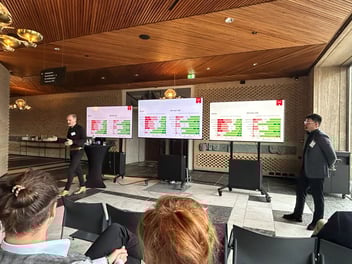
And as AI enters meeting rooms as a participant, the design requirements shift too. Microphones that distinguish individual voices. Displays positioned for shared AI output. Audio systems designed for natural AI responses. These go well beyond what we’ve typically asked of hybrid meeting rooms.
When AI becomes a participant in a meeting, how should the space respond?
We don’t have a definitive answer yet. But we believe the era when workplace design only needed to ask, “what do people need?” is ending. The next question is: “what do people and AI need in order to work together effectively?”
The First Task for Leadership: Write AI’s Job Description
What starts as individual efficiency gains will, before long, become an organisational question: in our company, what does AI own and what do people own?
Answering that is effectively writing a job description for AI. Which activities should AI handle? Which should remain with people? Which call for genuine collaboration? Defining this at an organisational level is what elevates AI from a productivity tool to a driver of real change.
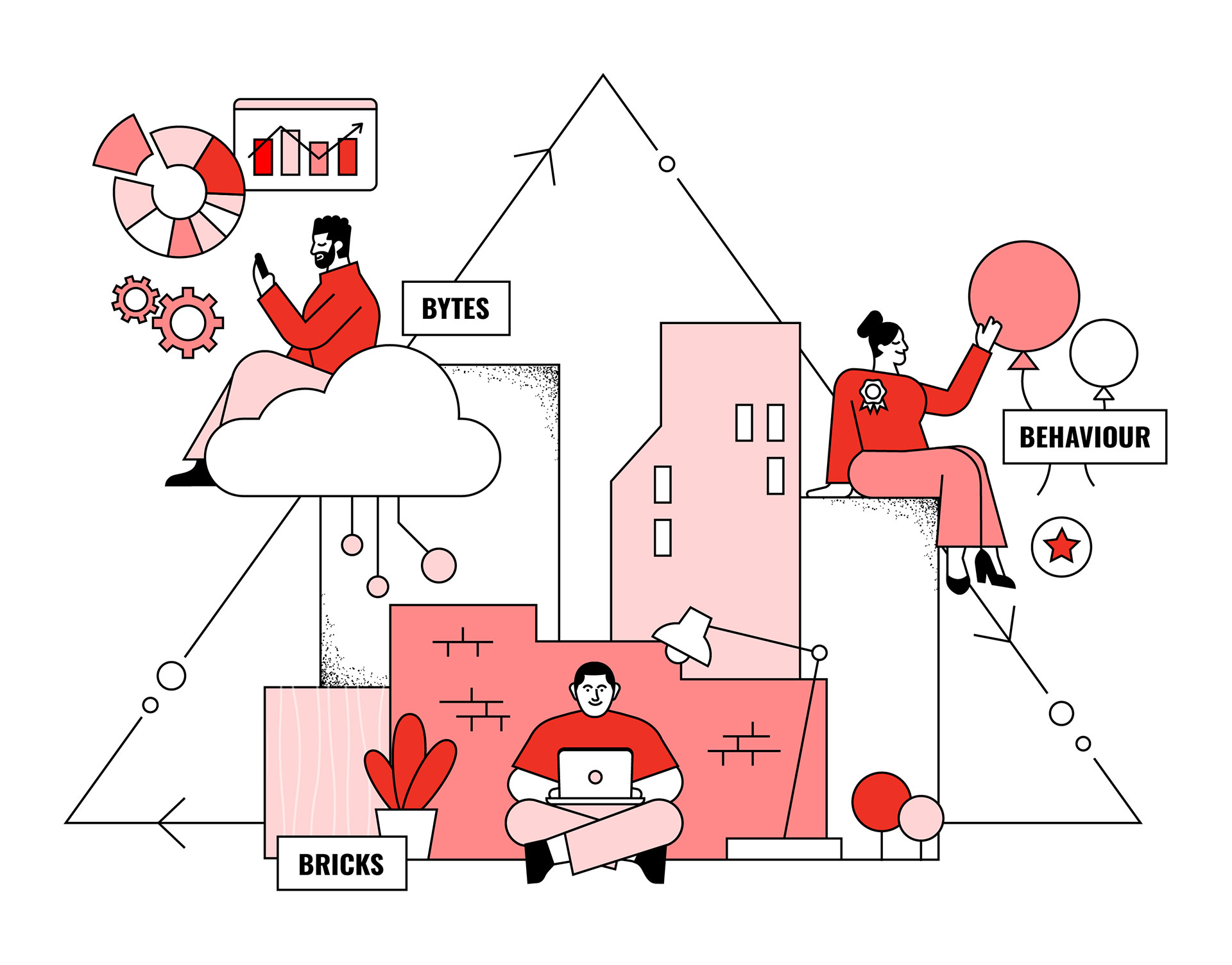
Only once that definition is in place can you clarify what you expect from employees, and redesign the three interdependent layers of work accordingly:
-
Behaviour: the culture built in the workplace
-
Bricks: the physical space
-
Bytes: the technology stack.
Implementing AI doesn’t require to approach these as separate problems, they’re a connected design challenge.
Deploying a tool and running a training session isn’t enough. Real change requires leadership to define what AI is responsible for, and then redesign how people work in response.
The Real Question Isn’t Whether to Use AI. It’s What Humans Should Do Instead.
As AI takes over routine tasks, what's left for people is the work that requires human judgment; navigating uncertainty, understanding what's unsaid, and building relationships that hold.
That means revisiting your activities, defining what belongs to AI and what belongs to people, and redesigning how you work as a whole. That's what transformation looks like, not a tool rollout, but a redesign.